Table of Contents
ToggleWorking from home doesn’t mean leaving security to chance. A dedicated office security camera protects equipment, monitors deliveries, and provides peace of mind whether someone’s on the clock or away for the weekend. Unlike whole-home systems, office cameras need specific features, sharp daytime detail for reading documents, reliable motion alerts that won’t ping every time the dog walks by, and discrete mounting that doesn’t scream “surveillance room.” This guide cuts through the marketing jargon to identify the cameras that actually perform in home office environments, along with straight talk on installation and setup.
Key Takeaways
- A best office security camera should deliver 1080p minimum resolution to read documents and identify equipment on desks, with 4K recommended if storage capacity allows.
- AI-powered person detection and activity zones reduce false alerts by 60–80% compared to basic motion sensors, keeping homeowners informed without constant interruptions.
- Office cameras prevent break-ins, document incidents for insurance claims, and enable remote monitoring of deliveries and workspace security without leaving home.
- Mount cameras 7–8 feet high in corners angled downward 15–20° for clear facial views while avoiding backlighting from windows that turns people into silhouettes.
- Quality infrared night vision extending 25–30 feet is essential for offices without 24/7 lighting; cheaper models maxing out at 15 feet won’t adequately cover standard home offices corner to corner.
- Hybrid storage combining local microSD card recording with cloud backup for flagged events provides reliable security without excessive monthly subscription costs.
Why Every Home Office Needs a Security Camera
Home offices accumulate value fast. Between computers, monitors, printers, and specialized equipment, the average setup runs $3,000-$8,000, more than many living rooms. Add client files, prototypes, or inventory for small businesses, and the stakes climb higher.
A security camera serves three practical functions. First, it deters break-ins. Visible cameras make opportunistic thieves move to easier targets. Second, it documents incidents. If something does go missing or gets damaged, footage provides evidence for insurance claims and police reports. Third, it enables remote monitoring. Homeowners can check on deliveries, verify the pet sitter showed up, or confirm the office door is locked without driving home.
For those running client-facing businesses from home, cameras also protect against liability claims. If a client alleges an incident occurred during a meeting, footage clarifies what actually happened. Some insurance policies for home-based businesses even offer premium discounts for documented security measures.
The key difference between office cameras and general home security: offices need detail. A camera that captures a fuzzy shape moving through a hallway won’t cut it when someone needs to read a document on a desk or identify a specific tool that went missing. Resolution, focal length, and lighting capabilities matter more in confined workspaces than wide-angle coverage.
Key Features to Look for in Office Security Cameras
Not all security cameras suit office environments. The features that matter in a nursery or front porch won’t necessarily translate to a workspace. Here’s what actually moves the needle.
Video Quality and Night Vision Capabilities
1080p resolution is the practical minimum for office use. At this resolution, users can read text on a monitor in playback or identify small objects on a desk. 4K cameras (2160p) provide even sharper detail, which helps when zooming into saved footage to catch serial numbers or document details. But, 4K files consume significantly more storage, roughly four times the space of 1080p, so budget for adequate cloud storage or a larger local SD card.
Frame rate affects motion clarity. Look for 15-20 frames per second (fps) minimum. Higher rates (30 fps) produce smoother video, which helps when reviewing fast movements like someone grabbing an item and leaving quickly.
For offices without 24/7 lighting, infrared (IR) night vision is essential. Quality cameras illuminate up to 25-30 feet in complete darkness using IR LEDs invisible to the human eye. Cheaper models often max out at 15 feet, which barely covers a standard 12’×14′ home office corner to corner. Check the listed IR range and compare it to actual office dimensions.
Some newer models offer color night vision using ambient light sensors and spotlight activation. This works well in offices with streetlight bleed or nightlights, producing full-color footage instead of black-and-white IR. The tradeoff: spotlights can be intrusive if the office shares a wall with a bedroom.
Smart Detection and Alert Systems
Basic motion detection triggers alerts every time a tree branch sways past the window. Modern offices need AI-powered detection that distinguishes between people, pets, and incidental movement.
Person detection uses machine learning to recognize human shapes and movement patterns. This cuts false alerts by 60-80% in typical home environments. Some advanced systems add facial recognition, which can differentiate between household members and strangers, useful for home offices that occasionally host clients or contractors.
Activity zones let users define specific areas for monitoring. In an office, set a zone around the desk and file cabinets while ignoring the doorway to the hallway. This prevents alerts every time someone walks past but maintains coverage where it counts.
Two-way audio turns a camera into an intercom. If someone’s in the office unexpectedly, the homeowner can speak through the camera from a phone app. Quality varies widely, look for cameras with noise cancellation and echo reduction, or the audio becomes an unusable mess of feedback.
Cloud vs. local storage affects both ongoing costs and footage access. Cloud storage typically runs $3-$10/month per camera for 30-60 days of rolling footage. Local storage uses a microSD card (usually 32-256GB) inserted in the camera, with no monthly fees but limited capacity. For offices, a hybrid approach works best: local storage for continuous recording with cloud backup for flagged events.
Top Office Security Camera Recommendations for Different Needs
Every office has different priorities. Here’s how different camera types match specific use cases, based on evaluations from independent security camera testing and real-world home office deployments.
Best overall for detail and features: Pan-tilt-zoom (PTZ) models with 2K-4K resolution. These cameras rotate on motorized mounts, covering wider areas without multiple camera installations. PTZ cameras excel in larger home offices (200+ sq ft) or dual-use spaces like garage workshops. The ability to remotely adjust the viewing angle means one camera can monitor the desk during work hours, then pivot to cover the door and windows overnight. Expect to pay $120-$250 for quality PTZ units with robust app controls.
Best for tight budgets: Fixed 1080p cameras with local storage. These no-frills units skip subscription fees by recording to microSD cards. Image quality from reputable manufacturers often matches pricier models, users sacrifice cloud access and advanced AI features, not core surveillance capability. Solid options run $35-$70. They work well for renters or anyone testing the waters before committing to a full system.
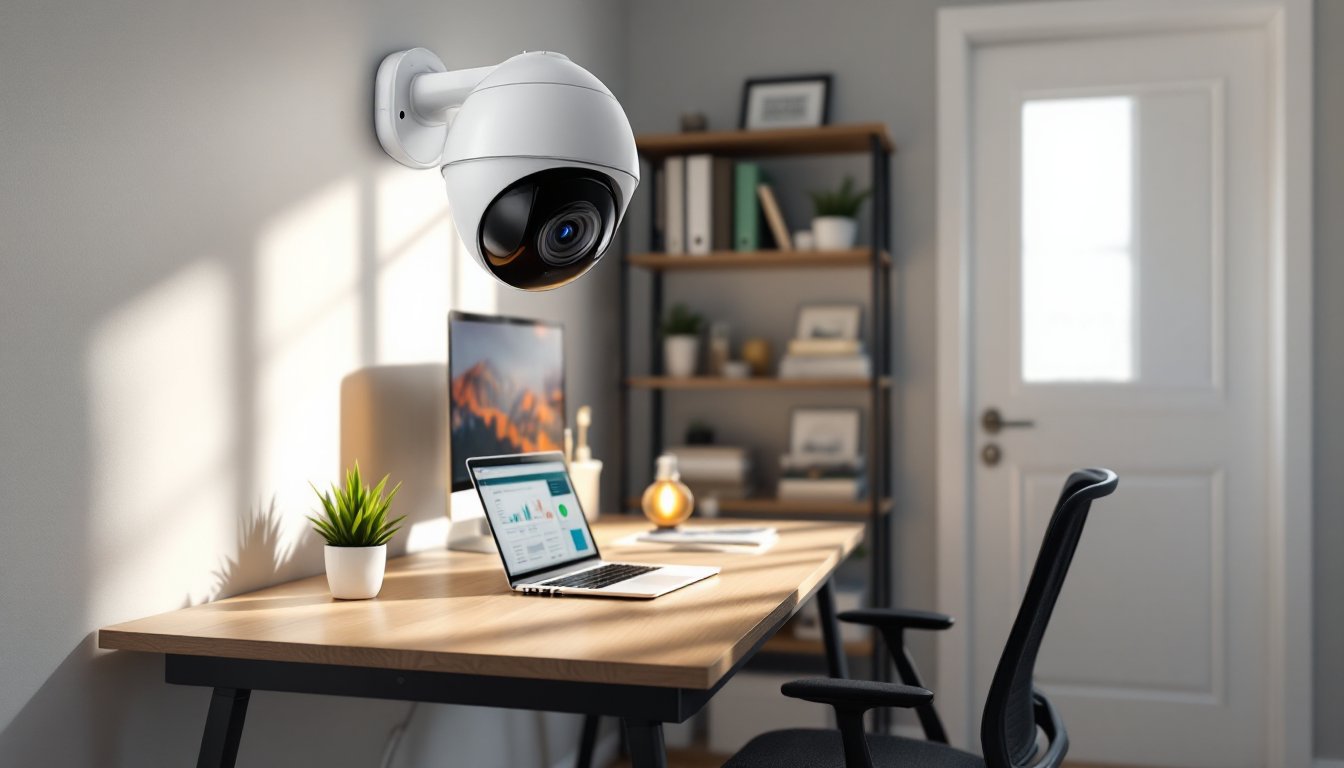
Best for discrete monitoring: Dome cameras with 130-150° wide-angle lenses. Unlike protruding bullet cameras, domes mount flush to ceilings and blend into office aesthetics. Wide-angle coverage means fewer cameras overall, and the dome housing makes it harder for intruders to determine exactly where the camera points. Recommended for client-facing home offices where overt surveillance feels uncomfortable. These typically cost $60-$140.
Best for integration with existing smart homes: Cameras that work natively with established ecosystems, Alexa, Google Home, Apple HomeKit. If the office already uses smart lighting or thermostats, a compatible camera enables unified control and automation. For example, set the camera to automatically start recording when smart locks register “away” mode. Compatibility cameras range from $70-$200 depending on resolution and features, with many detailed in comprehensive security camera reviews.
Best for professional-grade storage: Cameras with Network Video Recorder (NVR) compatibility. NVRs are dedicated devices that store footage from multiple cameras locally, offering weeks or months of searchable video without cloud subscriptions. They require ethernet wiring and technical setup, but provide enterprise-level control. Best for serious home businesses or multi-camera installations covering offices plus adjacent inventory storage. Budget $200-$400 for the NVR plus $80-$150 per camera.
Avoid gimmick features that sound useful but rarely get used: built-in sirens (too quiet to deter anyone determined), “gesture control” (unreliable in practice), and ultra-wide 180° lenses that distort edges so badly they’re useless for identification.
Installation Tips for DIY Home Office Security
Most home office cameras install in under an hour with basic tools. Here’s how to do it right the first time.
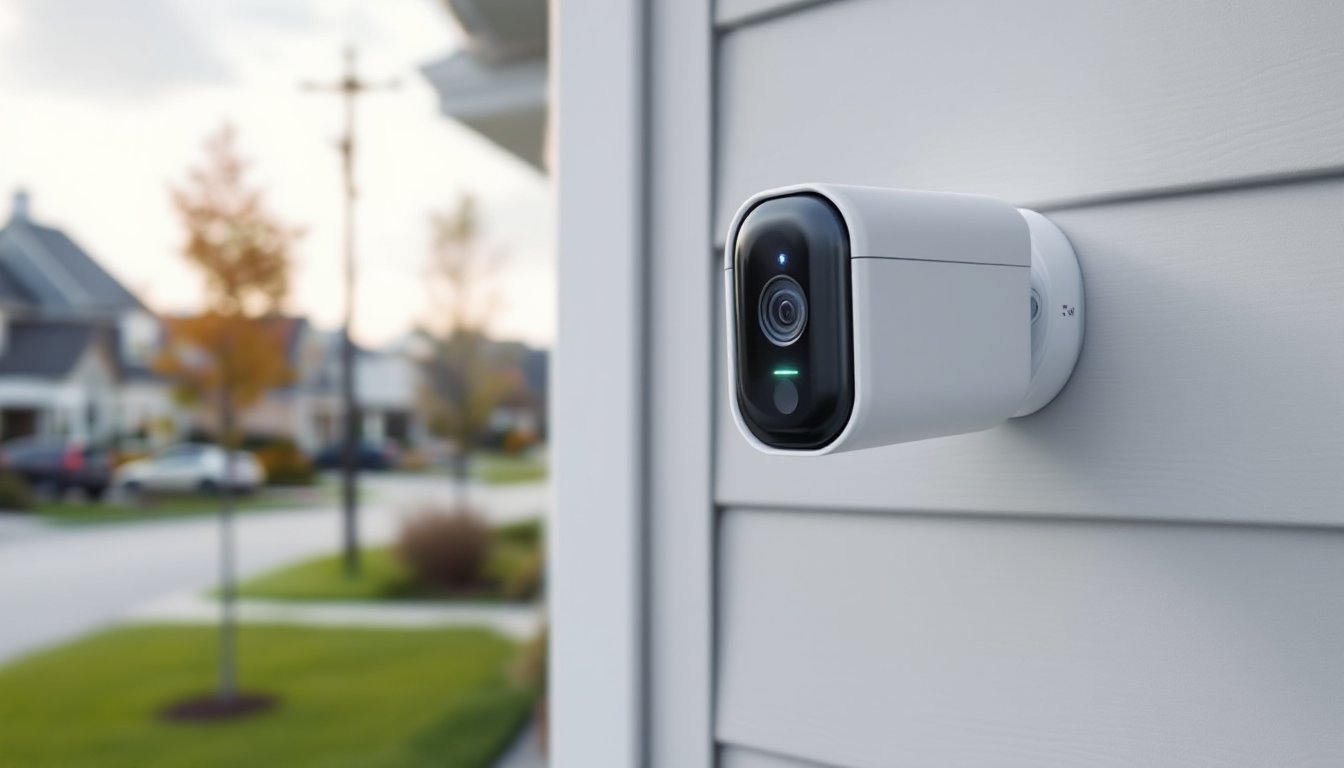
Placement strategy: Mount cameras in corners, 7-8 feet high, angled downward at 15-20°. This height defeats casual tampering while providing clear facial views of anyone standing or sitting in the space. Avoid mounting directly above bright windows, backlighting washes out faces and turns people into silhouettes. If window glare is unavoidable, adjust the camera’s wide dynamic range (WDR) setting in the app to balance bright and dark areas.
Power options: Most cameras use one of three power sources. Plug-in AC adapters are simplest but require an outlet within 6 feet unless an extension cord is added (check camera specs for power draw before using extensions). Power over Ethernet (PoE) delivers power and data through a single Cat5e/Cat6 cable, cleaner and more reliable, but requires either a PoE-enabled router or an injector adapter. Battery-powered cameras offer maximum flexibility for placement but need recharging every 2-6 months depending on activity levels. For offices, plug-in or PoE wins for reliability.
Wi-Fi considerations: Cameras stream video constantly, consuming significant bandwidth. A 1080p camera uses roughly 2-4 Mbps upload speed during active recording, while 4K jumps to 8-12 Mbps. Test Wi-Fi strength at the planned camera location using a phone app like WiFi Analyzer. If signal drops below three bars, consider a mesh network extender or a camera with ethernet backup. Weak signals cause choppy footage and missed motion events.
Mounting hardware: Most cameras include plastic anchors and screws for drywall. These work for cameras under 8 ounces. Heavier PTZ units (12+ oz) need toggle bolts or installation into wall studs for secure mounting. Use a stud finder to locate framing, or tap the wall and listen for the solid thud versus hollow sound. Mark stud locations before drilling.
Cable management: Exposed cables look sloppy and create trip hazards. Run cables along baseboards and door frames, securing them with cable clips every 12-18 inches. For cleaner aesthetics, route cables through walls using low-voltage mounting brackets, these don’t require electrical permits in most jurisdictions since camera systems operate under 50 volts. Just drill a small hole behind the camera and another near the floor, then fish the cable through using a coat hanger or fish tape.
Privacy considerations: Position cameras to avoid capturing neighbor windows or public spaces where people have reasonable privacy expectations. Some municipalities have specific regulations about recording audio without consent, check local laws. Within a home office, clearly disclose camera presence to any clients, contractors, or employees who enter the space.
Test the full system before finalizing installation. Walk through the office while watching the live feed from another room. Verify motion zones trigger correctly, night vision activates in darkness, and recorded footage saves properly. Adjust angles and settings as needed, it’s much easier to tweak before mounting becomes permanent. Many of these setup practices align with recommendations from professional security camera guides used by installers nationwide.
Conclusion
A well-chosen security camera transforms a home office from vulnerable to monitored without complex installation or ongoing costs. Focus on resolution that captures detail, smart detection that cuts false alerts, and mounting that covers entry points and high-value equipment. Most DIYers can install and configure a quality camera in a single afternoon, gaining immediate peace of mind and long-term documentation. Match features to actual office needs rather than spec sheet bragging rights, and the system will perform reliably for years.